
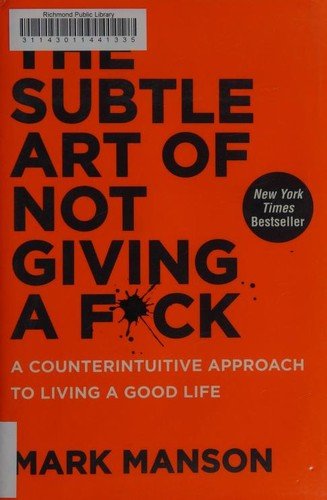
Highly recommended
The Subtle Art of Not Giving a F*ck
A Counterintuitive Approach to Living a Good Life
Stop trying to care about everything. Choose what's worth caring about, and accept that struggle is part of a good life.
- Published 2016
- Easy read
- Philosophy and ideas
- 2 min analysis
As an Amazon Associate I earn from qualifying purchases.
Introduction
Mark Manson started as a blogger writing frank, profane advice before this book became an international bestseller in 2016. He argues that much self-help, with its relentless positivity, makes us feel worse by reminding us of what we lack.
Instead, he suggests choosing carefully what to care about, accepting that life involves struggle, and taking responsibility for our problems.
Who should read this book?
Readers tired of upbeat self-help who want blunt, humorous honesty. Strong language throughout.
Helps with: Bounce back from setbacks, Find purpose and direction
The central message
You can't care about everything. Choose your values wisely, accept pain as part of life, and take responsibility for your problems.
Key ideas and concepts
Choose what to care about
We have limited attention and energy. Caring less about trivial things leaves room to care about what truly matters.
The feedback loop from hell
Feeling bad about feeling bad makes things worse. Accepting negative emotions breaks the loop.
Problems never stop
Happiness comes from solving good problems, not from having no problems.
Responsibility vs fault
Something may not be your fault, but how you respond is your responsibility.
Good values
Values that are reality-based, socially constructive and controllable, like honesty, lead to better lives than values like popularity or always feeling good.
Deeper analysis
Manson's book succeeds by puncturing the clichés of positive thinking. Its central idea, that a good life is about choosing worthwhile struggles, is wise and draws on Stoic and Buddhist thought. The distinction between fault and responsibility is particularly useful, and the humour makes the medicine go down.
The profanity and swagger will put some readers off, and the book is more a collection of essays than a structured programme. Some readers find it repetitive or feel the tone undercuts its sincerity. Its ideas aren't new, but Manson presents them in a fresh, memorable way for people who'd never pick up a philosophy book.
Practical applications
- List what you currently care about and cross off what doesn't matter.
- Pick a 'good problem' you're willing to struggle with.
- Take responsibility for one situation you've blamed on others.
- Let yourself feel a negative emotion without judging it.
- Choose one value to guide your decisions this week.
Your 7-day action plan
- Day 1
List what you spend energy caring about.
- Day 2
Identify trivial worries to drop.
- Day 3
Name a problem worth struggling for.
- Day 4
Take responsibility for one challenge.
- Day 5
Notice and accept a negative emotion.
- Day 6
Choose and act on a good value.
- Day 7
Reflect on what you want to care about.
Outcomes to expect
What readers who apply this book can realistically take away from it:
- Clearer priorities
- Greater acceptance of difficulty
- Stronger sense of responsibility
- Less pressure to feel good all the time
Strengths and limitations
Strengths
- Honest, funny and refreshing
- Wise ideas drawn from philosophy
- Memorable distinction between fault and responsibility
- Accessible to readers who dislike self-help
Limitations
- Heavy profanity won't suit everyone
- Loosely structured, more essays than programme
- Ideas are not new
Reflection questions
- What do you care about that doesn't really matter?
- Which problems are worth your struggle?
- What are you blaming others for that you could take responsibility for?
- What values guide your life?
Related books
Atomic Habits
James Clear
Small changes, repeated daily, add up to a life that looks completely different. A clear, practical system…
Man's Search for Meaning
Viktor E. Frankl
Even in the worst conditions, we can choose our attitude and find meaning. One of the most influential books…



About the author
Explore the book
Read reviews, see formats (print, Kindle, audiobook) and check the current price.
See it on AmazonAs an Amazon Associate I earn from qualifying purchases.
Book details (title, author, year) are factual. Everything under the headings above is MindsetProdigy's own editorial analysis and interpretation, written to help you decide whether to read the book and how to apply it. It is not a substitute for reading the book itself. Last updated September 27, 2026.