
Recommended
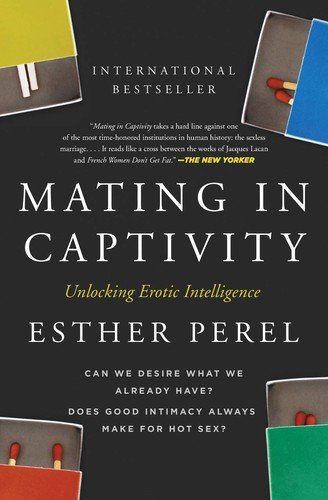
Mating in Captivity
Unlocking Erotic Intelligence
Why desire fades in long relationships, and how to keep it alive. A thoughtful, cross-cultural exploration.
- Published 2006
- Moderate
- Philosophy and ideas
- 2 min analysis
As an Amazon Associate I earn from qualifying purchases.
Introduction
Esther Perel is a Belgian-born psychotherapist based in New York. Mating in Captivity, published in 2006, explores why desire often fades in long-term relationships even when love remains.
Perel argues that love seeks closeness and security, while desire needs distance, mystery and freedom, and that couples must balance the two.
Who should read this book?
Long-term couples who love each other but feel desire has faded, and anyone curious about intimacy.
Helps with: Improve my relationships
The central message
Desire and domesticity pull in different directions. Couples can rekindle desire by cultivating separateness, mystery and playfulness alongside security.
Key ideas and concepts
Love and desire pull in different directions
Love seeks closeness, security and familiarity; desire thrives on distance, novelty and mystery.
Too much fusion
When couples merge completely, they can lose the sense of the 'other' that fuels desire.
Seeing your partner anew
Perel notes that people often feel most drawn to partners when watching them confident and absorbed in their element.
Eroticism and imagination
Desire involves play, imagination and curiosity, not only technique.
Parenthood and desire
Children reshape couples' attention and energy, and many need to deliberately protect their erotic connection.
Deeper analysis
Mating in Captivity is insightful, nuanced and culturally rich. Perel challenges the common belief that more closeness and communication always lead to better sex, offering instead a view in which desire needs space, separateness and mystery. Her stories from therapy are vivid, and many couples find the book opens new conversations.
It's more reflective than practical, offering few structured exercises. Some readers find its ideas challenging to their values or its European perspective unfamiliar, and it focuses on couples who are otherwise relatively stable. Still, it's one of the most important books on desire in long-term relationships.
Practical applications
- Spend time pursuing separate interests.
- Watch your partner in their element.
- Introduce novelty into your relationship.
- Talk about desire openly.
- Prioritize playfulness.
Your 7-day action plan
- Day 1
Reflect on love vs desire.
- Day 2
Do something independently.
- Day 3
Observe your partner in their element.
- Day 4
Try something new together.
- Day 5
Have an open conversation about desire.
- Day 6
Plan a playful activity.
- Day 7
Reflect together.
Outcomes to expect
What readers who apply this book can realistically take away from it:
- A new understanding of love and desire
- Balance between closeness and separateness
- Renewed curiosity about your partner
- More open conversations about intimacy
Strengths and limitations
Strengths
- Insightful, nuanced view of desire
- Culturally rich and beautifully written
- Challenges common assumptions about intimacy
- Opens new conversations for couples
Limitations
- More reflective than practical
- May challenge some readers' values
- Few structured exercises
Reflection questions
- When do you feel most drawn to your partner?
- How much separateness do you have?
- What novelty could you add?
- How do you talk about desire?
Related books
How to Win Friends and Influence People
Dale Carnegie
The classic guide to getting along with people, still useful nearly a century later.
The Four Agreements
Don Miguel Ruiz
Four simple promises to yourself that can free you from a lot of unhappiness.



About the author
Explore the book
Read reviews, see formats (print, Kindle, audiobook) and check the current price.
See it on AmazonAs an Amazon Associate I earn from qualifying purchases.
Book details (title, author, year) are factual. Everything under the headings above is MindsetProdigy's own editorial analysis and interpretation, written to help you decide whether to read the book and how to apply it. It is not a substitute for reading the book itself. Last updated September 28, 2026.