
Highly recommended
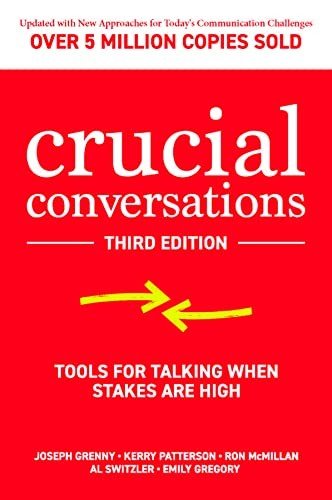
Crucial Conversations
Tools for Talking When Stakes Are High
How to talk about hard things without blowing up or shutting down.
- Published 2002
- Moderate
- Practical guidance
- 2 min analysis
As an Amazon Associate I earn from qualifying purchases.
Introduction
Crucial Conversations was written by Kerry Patterson, Joseph Grenny, Ron McMillan and Al Switzler, founders of the training company VitalSmarts (now Crucial Learning). First published in 2002, it focuses on conversations where stakes are high, opinions differ and emotions run strong.
The authors argue that how we handle these moments shapes careers, relationships and organizations, and that the skills can be learned.
Who should read this book?
Managers, team members, couples, parents and anyone who avoids or mishandles difficult conversations.
Helps with: Communicate and persuade, Lead and grow at work
The central message
When stakes are high, keep dialogue open by making it safe to speak, staying focused on what you really want, and sharing facts before stories.
Key ideas and concepts
Start with heart
Ask what you really want for yourself, the other person and the relationship, and avoid the 'fool's choice' between honesty and kindness.
Learn to look
Watch for signs that safety is breaking down: silence (withdrawing, sugar-coating) or violence (attacking, labelling).
Make it safe
Restore mutual purpose and mutual respect, apologize when appropriate, and use contrasting statements to clarify intent.
Master your stories
Notice the stories you tell yourself about others' motives, and separate facts from interpretations.
STATE your path
Share facts, Tell your story, Ask for others' paths, Talk tentatively and Encourage testing.
Deeper analysis
Crucial Conversations offers practical, well-structured tools for difficult conversations. Concepts like the fool's choice and the 'path to action' from facts to stories to feelings help readers understand why conversations go wrong and what to do instead. Its methods are widely used in organizations and suit both work and personal life.
The many acronyms and frameworks can feel corporate and hard to remember in the heat of the moment, and the examples sometimes feel artificial. Real conversations also involve power imbalances that the book addresses only lightly. Practising the skills in low-stakes situations first is key. It remains one of the best guides to high-stakes dialogue.
Practical applications
- Before a hard conversation, write what you really want.
- Notice when you or others move to silence or violence.
- Use a contrasting statement: 'I don't mean… I do mean…'
- Share facts before your interpretation.
- Invite the other person to share their view.
Your 7-day action plan
- Day 1
Identify a conversation you've been avoiding.
- Day 2
Clarify what you really want.
- Day 3
Separate facts from your story.
- Day 4
Practise a contrasting statement.
- Day 5
Have the conversation using STATE.
- Day 6
Reflect on what went well.
- Day 7
Plan your next crucial conversation.
Outcomes to expect
What readers who apply this book can realistically take away from it:
- Confidence in high-stakes conversations
- Better ability to keep dialogue safe
- Less avoidance and fewer blow-ups
- Clearer, more honest communication
Strengths and limitations
Strengths
- Practical, structured tools
- Widely used and tested in organizations
- Applies to work and personal life
- Helps separate facts from stories
Limitations
- Many acronyms can feel corporate
- Examples sometimes feel artificial
- Addresses power imbalances only lightly
Reflection questions
- Which conversation are you avoiding?
- Do you tend toward silence or violence?
- What story are you telling yourself?
- What do you really want from the conversation?
Related books
How to Win Friends and Influence People
Dale Carnegie
The classic guide to getting along with people, still useful nearly a century later.
Getting to Yes
Roger Fisher, William Ury and Bruce Patton
Separate people from the problem and focus on interests, not positions. The classic of principled negotiation.


About the authors
Explore the book
Read reviews, see formats (print, Kindle, audiobook) and check the current price.
See it on AmazonAs an Amazon Associate I earn from qualifying purchases.
Book details (title, author, year) are factual. Everything under the headings above is MindsetProdigy's own editorial analysis and interpretation, written to help you decide whether to read the book and how to apply it. It is not a substitute for reading the book itself. Last updated September 28, 2026.