

Highly recommended
Difficult Conversations
How to Discuss What Matters Most
Every difficult conversation is really three: what happened, feelings and identity. How to handle all three.
- Published 1999
- Moderate
- Practical guidance
- 2 min analysis
As an Amazon Associate I earn from qualifying purchases.
Introduction
Douglas Stone, Bruce Patton and Sheila Heen were members of the Harvard Negotiation Project. Difficult Conversations, first published in 1999, explains why conversations about sensitive topics go wrong and how to handle them better.
The authors argue that every difficult conversation is really three conversations at once.
Who should read this book?
Anyone facing a hard conversation with a partner, family member, colleague or manager.
Helps with: Communicate and persuade, Improve my relationships
The central message
Difficult conversations involve three layers: what happened, feelings and identity. Shifting to a 'learning conversation' helps.
Key ideas and concepts
The 'what happened?' conversation
We argue about facts, intentions and blame, each convinced our story is the truth.
The feelings conversation
Emotions sit at the heart of difficult conversations and leak out if ignored.
The identity conversation
Hard conversations threaten how we see ourselves: as competent, good or worthy of love.
Separate intent from impact
Don't assume others meant to hurt you just because you were hurt, and recognize your impact even if you meant well.
Contribution, not blame
Explore how each person contributed to the problem, which leads to learning rather than defensiveness.
Begin from the third story
Open by describing the situation as a neutral observer would.
Deeper analysis
Difficult Conversations is thoughtful and practical. Its three-conversation framework, what happened, feelings and identity, helps readers understand what's going on beneath the surface of hard talks, and its shifts from blame to contribution, from certainty to curiosity and from debate to learning can transform conflicts at work and at home. It's one of the most respected books from the Harvard Negotiation Project.
It's long and can feel dense, and some example dialogues seem artificial. The approach assumes both parties are willing to engage in good faith. Still, it's among the best books on handling the conversations we most want to avoid.
Practical applications
- Map a conversation's three layers.
- Separate intent from impact.
- Explore your contribution.
- Acknowledge feelings.
- Begin from the third story.
Your 7-day action plan
- Day 1
Identify a difficult conversation you've been avoiding.
- Day 2
Write the 'what happened' story from their perspective.
- Day 3
Name the feelings involved, yours and theirs.
- Day 4
Reflect on what the conversation threatens in your identity.
- Day 5
Write an opening that starts from the 'third story'.
- Day 6
Have the conversation with curiosity rather than certainty.
- Day 7
Reflect on what you learned and what you'd do differently.
Outcomes to expect
What readers who apply this book can realistically take away from it:
- Understanding of what drives difficult conversations
- Less blame and defensiveness
- Better listening and curiosity
- More productive outcomes
Strengths and limitations
Strengths
- Insightful three-conversation framework
- Covers emotions and identity, not just facts
- Practical shift from blame to contribution
- Widely respected
Limitations
- Long and dense
- Example dialogues can feel artificial
- Assumes good faith from both sides
Reflection questions
- What happened from their view?
- What are you feeling?
- What does this say about your identity?
- How did you contribute?
Related books
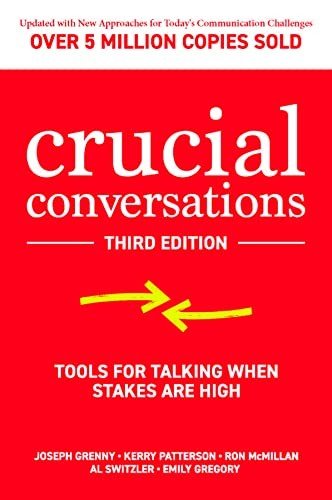
Crucial Conversations
Kerry Patterson, Joseph Grenny, Ron McMillan and Al Switzler
Tools for high stakes.
How to Win Friends and Influence People
Dale Carnegie
The classic guide to getting along with people, still useful nearly a century later.
Getting to Yes
Roger Fisher, William Ury and Bruce Patton
Separate people from the problem and focus on interests, not positions. The classic of principled negotiation.



About the authors
Explore the book
Read reviews, see formats (print, Kindle, audiobook) and check the current price.
See it on AmazonAs an Amazon Associate I earn from qualifying purchases.
Book details (title, author, year) are factual. Everything under the headings above is MindsetProdigy's own editorial analysis and interpretation, written to help you decide whether to read the book and how to apply it. It is not a substitute for reading the book itself. Last updated September 28, 2026.